
Denver Home Equity Calculator: How Much of Your Home Do You Own?
Here's a question we hear all the time around Denver: "How much is my house worth, and how much of it is actually mine?" Our free Denver home equity calculator answers the second part in about a minute. In this post, we cover what home equity actually is, how it has moved around the Denver metro, and seven practical ways to put your number to work.
Key takeaways
- Home equity is what your home is worth minus what you still owe on it (Consumer Financial Protection Bureau).
- U.S. homeowners with a mortgage had $310,000 in equity on average in Q2 2026 (Cotality, Sept. 10, 2026).
- Denver-metro home prices rose 12.36% over the five years ending Q2 2026 and dipped 0.98% over the last year (FHFA House Price Index, 2026Q2 report, p. 18).
- The 30-year mortgage rate averaged 7.24% on Oct. 29, 2026 (Freddie Mac PMMS).
- Our free equity calculator gives you an estimate without a sign-up or a credit check.
What is home equity?
Home equity is the part of your home's value you own outright: its current value minus any mortgage you still owe. That's the Consumer Financial Protection Bureau's definition, and it's the one we use too.
Think of it like a jar you fill two ways. Every mortgage payment drops a little in, because part of each payment pays down your loan. And when home values in your area rise, the jar fills on its own. When values fall, some of it can leak back out.
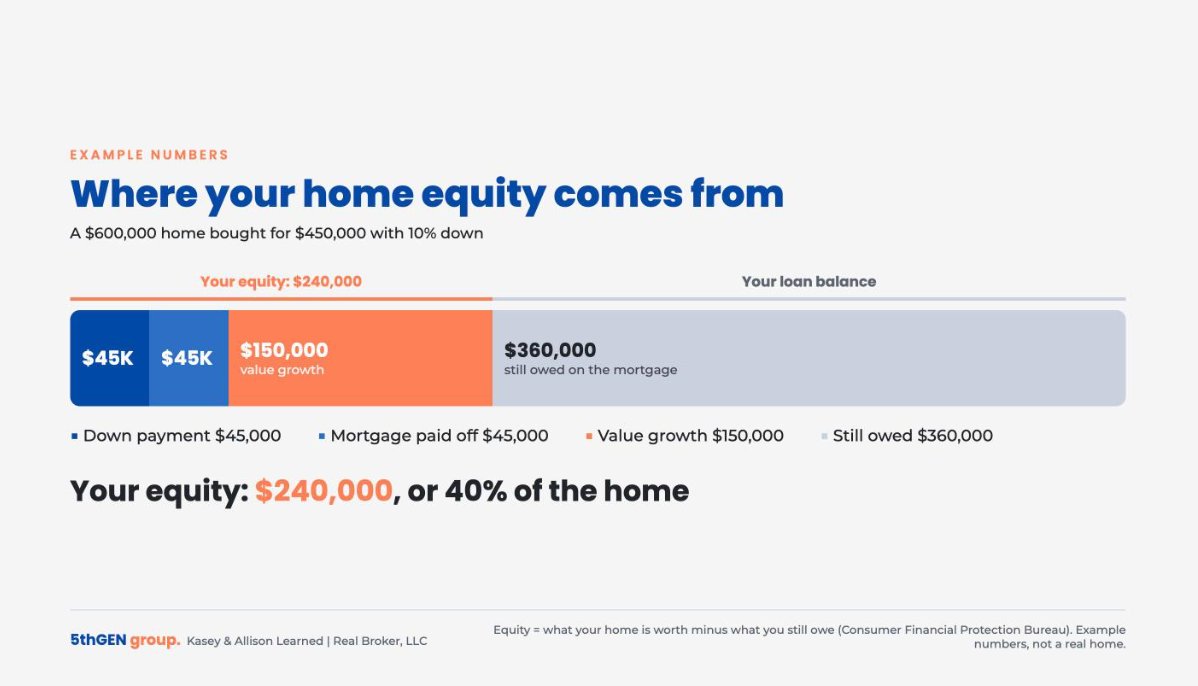
Here's how that adds up, using example numbers:
| Piece of your equity | Example |
|---|---|
| You bought for | $450,000 |
| Your down payment (10%) | $45,000 |
| Mortgage you've paid off since | $45,000 |
| Home value growth since you bought ($600,000 today) | $150,000 |
| Your equity ($600,000 value minus $360,000 still owed) | $240,000, or 40% of the home |
The three pieces in the middle always add up to your total. Our calculator breaks your equity down the same way.
Has home equity grown in the Denver metro?
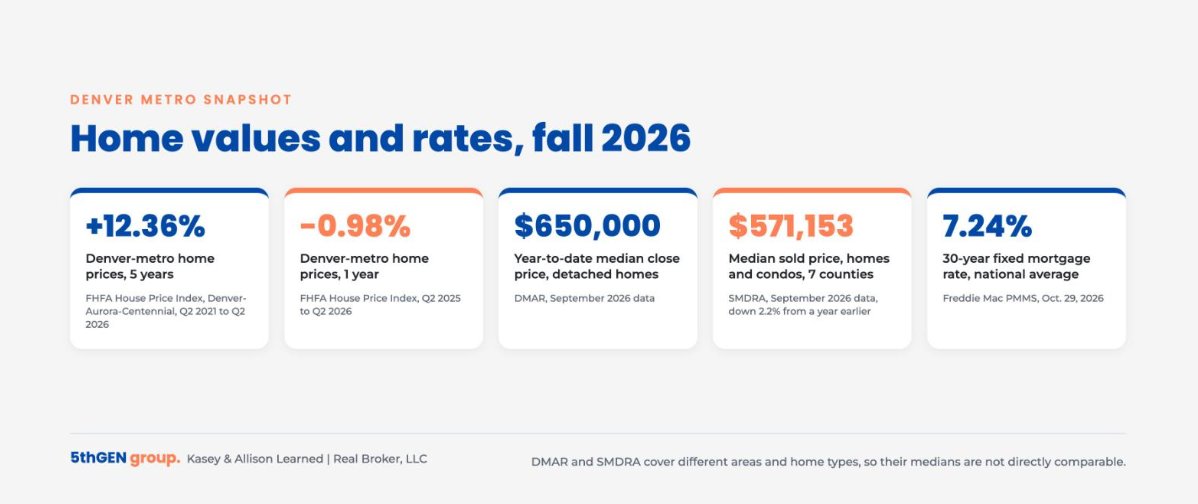
For most people who've owned a home for a few years, yes. The Federal Housing Finance Agency (FHFA) tracks prices on homes that sell more than once. In the Denver-Aurora-Centennial metro, its index rose 12.36% over the five years ending in the second quarter of 2026. Over the most recent year, it slipped 0.98% (FHFA, 2026Q2 report, p. 18).
So a long-time owner has likely gained. Someone who bought in 2025 may be close to where they started, and their equity comes mostly from their down payment and payments so far.
The latest local numbers point the same way: steady, not soaring.
- DMAR (Denver Metro Association of Realtors), September 2026 data, published Oct. 3, 2026: the year-to-date median close price for detached homes was $650,000, with 4.76 months of inventory across the metro (DMAR Market Trends, September 2026).
- SMDRA (South Metro Denver Realtor Association), September 2026 data: the median sold price for single-family homes and condos combined was $571,153 across seven counties (Adams, Arapahoe, Broomfield, Denver, Douglas, Elbert, and Jefferson), down 2.2% from $584,011 in September 2025 (SMDRA Market Statistics, September 2026).
- Mortgage rates: Freddie Mac's 30-year fixed average was 7.24% on Oct. 29, 2026, down from 7.32% the week before (Freddie Mac PMMS).
DMAR and SMDRA measure different areas and home types, so these two medians aren't meant to be compared with each other.
What this means for you: We think now is a good time to know your real number. Prices aren't climbing fast enough to bail anyone out of a guess, and with rates in the 7s, decisions about selling, refinancing, or borrowing against your home deserve actual math. For more on this month's market, see our Denver housing market update for November 2026.
How to use the 5thGEN equity calculator
- Enter your address. The calculator looks up public property, purchase, and mortgage records so you don't have to dig up paperwork.
- Confirm the details. It fills in an estimated value, what you paid, your down payment, what you still owe, and when you bought. Fix anything that looks off.
- See your equity. You get your estimated total equity, the percent of your home you own, and the breakdown: value growth, down payment, and mortgage paid off.
- Want an exact number? Tap "Get a free market analysis" at the bottom, and we'll walk you through what your equity means for selling, refinancing, or staying put.
Try the free equity calculator here. It's free, and you won't need to sign up or have your credit pulled.
One honest note: the result is an estimate built from public records. It isn't an appraisal, and it can't see your new kitchen or the roof you replaced last spring. That's what a market analysis is for.
7 ways to use your home equity number
Once you know your number, here's what it can help with.
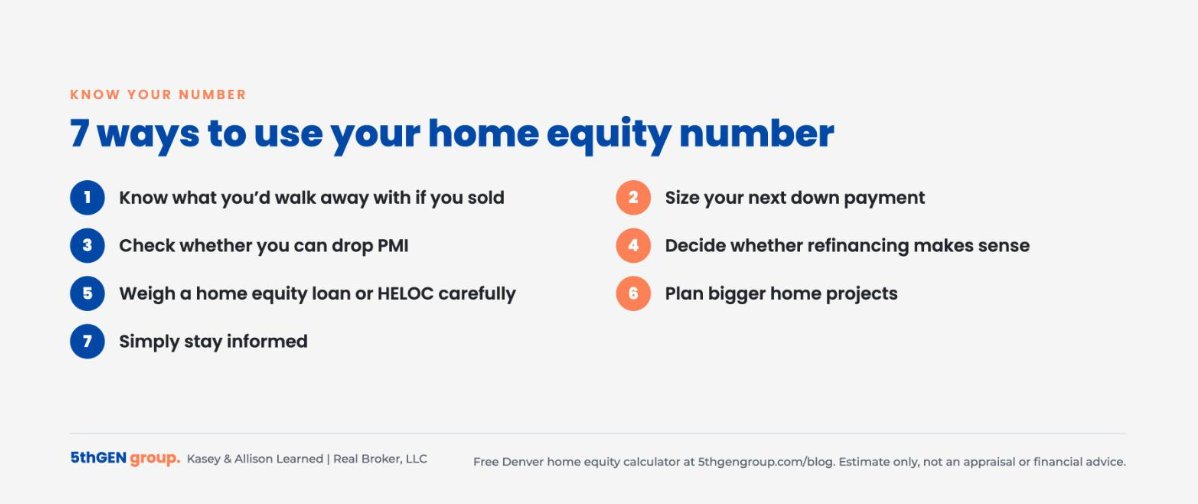
- Find out what you'd walk away with if you sold. Your equity is the starting point for your net proceeds. Subtract selling costs like commissions, title fees, and any repairs, and you'll know what you'd actually take to your next home.
- Size your next down payment. If you're thinking about moving up or downsizing, your equity shows how much you could put down on the next place, which affects your monthly payment.
- Check whether you can drop PMI. Private mortgage insurance (PMI) protects the lender when you put less than 20% down. If your equity has grown past that mark, ask your loan servicer about removing it.
- Decide whether refinancing makes sense. With the 30-year rate at 7.24% (Freddie Mac, Oct. 29, 2026), refinancing only helps some owners. Your equity and current rate are the two numbers a lender will ask about first.
- Weigh a home equity loan or HELOC carefully. A home equity loan lets you borrow using your equity as collateral (CFPB). That means your home is on the line, so talk with a lender and a financial advisor before you borrow.
- Plan bigger home projects. Knowing what you own helps you judge which upgrades make sense for how long you plan to stay.
- Stay in the loop. Your home is probably your biggest asset. Checking your number once a year, the way you'd check a retirement account, keeps surprises away.
We're real estate brokers, not lenders or financial advisors, so for loans and refinancing, a licensed lender is the right next call.
Is the calculator the same as an appraisal?
No. The calculator gives a quick estimate from public records. An appraisal is a licensed appraiser's formal opinion of value, usually ordered by a lender. Our market analysis sits in between: we review recent nearby sales and your home's condition to give you a realistic price range. If you're in Littleton or nearby, our Littleton market page is a good place to see what's selling.
Frequently asked questions
How do I calculate my home equity?
Take your home's current value and subtract what you still owe on your mortgage and any other loans secured by the home (CFPB). Our free calculator does the lookup and the math for you.
Does my down payment count as equity?
Yes. Your down payment was your first slice of ownership. It stays part of your equity, along with every dollar of principal you've paid and any rise in your home's value.
Can I lose home equity?
Yes. If your home's value falls, your equity shrinks with it, even if you've never missed a payment. If it drops far enough, you can end up "underwater," owing more than the home is worth. Nationally, 2.1% of mortgaged homes were underwater in Q2 2026 (Cotality, Sept. 10, 2026).
Is the equity calculator free?
Yes. There's no sign-up and no credit pull. If you'd like a more exact number, you can request a free market analysis from us at the end of the calculator.
How accurate is a home equity estimate?
It's only as good as the public records and value estimate behind it. Use it as a starting point. For a number you can make decisions with, ask for a market analysis.
Know your number
We set up this calculator because we think every homeowner deserves to know where they stand, whether or not they ever plan to move. Run your number, and if anything surprises you, we're happy to talk it through. You can request a free home value analysis or email us at hello@5thgengroup.com.
Kasey & Allison Learned, 5thGEN Group | Real Broker, LLC
Written by Kasey Learned, Broker Associate with Real Broker, LLC, and a fifth-generation Colorado native. 5thGEN Group serves the Denver metro. Last updated Oct. 30, 2026.
The equity calculator provides an estimate only. It is not an appraisal or financial advice.
Sources
- Consumer Financial Protection Bureau, "What is a home equity loan?", page last modified Sept. 13, 2024. Link (checked Oct. 30, 2026)
- Cotality, "Record home equity builds, yet remains untouched by borrowers," Sept. 10, 2026, Q2 2026 data. Link (checked Oct. 30, 2026)
- Federal Housing Finance Agency, "FHFA House Price Index Report - 2026Q2," released Aug. 25, 2026, Q2 2026 data, p. 18. Link (checked Oct. 30, 2026)
- Denver Metro Association of Realtors, "DMAR Real Estate Market Trends Report | September 2026," Oct. 3, 2026, September 2026 data. Link (checked Oct. 30, 2026)
- South Metro Denver Realtor Association, "SMDRA Market Statistics - September 2026" (PDF), September 2026 data. Link (checked Oct. 30, 2026)
- Freddie Mac, "Primary Mortgage Market Survey," Oct. 29, 2026. Link (checked Oct. 30, 2026)
Recent Posts



Broker Associate FA 100113033REColorado MLS ID 155069747
+1(970) 303-9607 | kasey@5thgengroup.com